Showing posts with label Risk adjustment solution HCC Coding. Show all posts

Monday, November 29, 2021

Best Risk Adjustment Solutions for Health Plans

The Risk Adjustment (RA) initiative is one of three risk-sharing initiatives intended to minimize the costs and risks that insurance providers encounter in the healthcare insurance exchanges introduced by the Affordable Care Act (ACA). Risk adjustment, as explained by the Centers for Medicare and Medicaid Services (CMS), forecasts individuals' potential healthcare costs based on diagnoses and demographic groups. Risk adjustment changes reimbursements of all providers depending on an estimate of the cost of the patient's treatment.


Healthcare financial institutions employ appropriate effective, thorough
Risk Adjustment Solutions, which necessitates taking a multitude of elements into consideration, including efficacy, compliance management, and patients' and healthcare providers’ contentment.

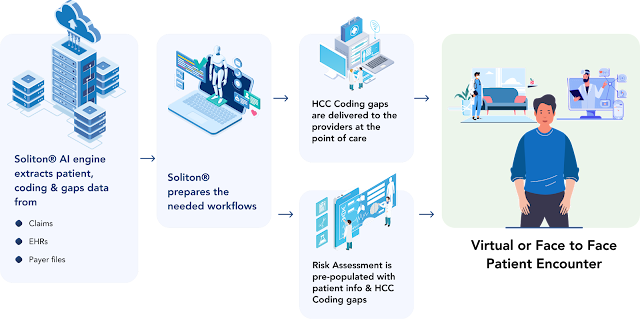
Efficient Risk Adjustment Model for Healthcare Plans involves the latest software to increase data analytics, collect indicated but unaccounted for diseases, seek health records with the better potential of generating excess coverage, and represent the real expense of the participant population. The adaptable and configurable strategy integrates risk-adjustment initiatives, combines analytics, and generates dashboards that look pretty familiar. The adaptable and configurable strategy integrates risk-adjustment initiatives, combines analytics, and generates dashboards that look pretty familiar.

CMS-HCC Coding Model

CMS employs Hierarchical Condition Category (HCCs Coding) to compensate Medicare Advantage plans depending on their participants' wellness. It precisely compensates for patients' projected cost spending by adjusting reimbursements depending on socio-economic data and patient health conditions.

The risk adjustment identifies individuals who need treatment planning and calculates the financial services granted by CMS towards each individual's yearly treatment by applying HCC Coding. Each individual diagnosis is utilized to produce the Risk Adjustment Factor (RAF), and the rating is used to evaluate not just payer coverage but also future possible expenditures connected with each patient. For HCC Coding to be effective, the insurance company must submit all diagnoses that influence the patient's assessment, care, and therapeutic interventions, including co-existing chronic conditions, comorbidities, and therapies delivered.

Modern Risk Adjustment Solutions Require Natural Language Processing (NLP)

Health insurance companies can effectively and efficiently risk categorizing their members using the NLP-aided coding system, concentrating on those with the most misdiagnosed symptoms and the largest number of claimed source codes without reference. This NLP-assisted risk classification adds tremendous value by allowing professionals to pick the most important members first and then navigate their way down the list of priorities.

NLP automation can speed up the data recovery method by enhancing searching, assembling, and automated data extraction. It helps eliminate or drastically lower chart hunt problems and improves efficiency, cost, and annoyance on both sides.



Tuesday, November 16, 2021

The Optimized Risk Adjustment Solution in 2021

Risk Adjustment (RA) is a statistical approach that considers health coverage subscribers’ underlying health conditions and healthcare costs while analyzing healthcare outcomes or expenses. Risk Adjustment Solutions help in ensuring compliance, precise compensation for beneficiaries' risk costs.


The COVID-19 pandemic levied a burden on the whole healthcare industry, particularly for the Risk Adjustment. The upheaval caused by the pandemic resulted in negative repercussions, including declines in preventative interactions such as yearly health and wellbeing checkups. There are some positive outcomes as well, such as the expansion of telehealth adoption among providers.

However, the year 2021 has shown a distinct potential to become a year of optimized risk adjustment. With the implementation of the American Rescue Plan Act of 2021, Consolidated Omnibus Budget Reconciliation Act (COBRA)  constraints and rates have been decreased and some are even removed. The legislation modifies various healthcare insurance programs to broaden Medicaid subsidy-eligibility and enhance government financial assistance for insurance plans while permitting the Affordable Care Act (ACA) exchange an off-calendar second opportunity to open.

Medicare Advantage (MA) registration is surging, with 2.4 million new subscribers, a 9.9 percent increase year on year, which further overlaps with the MA 2020 dates of service (DOS) filing closing date extension. The first objective is to regulate income and guarantee no gaps in the 2019-2020 population RAF. Another way to income continuity is to work on detecting overlooked and under-coded variables that might yield funding soon, for 2021 dates of service (DOS). Speculative solutions, such as Lumanent Pre-Encounter Prep, a National Language Processing (NLP) powered advanced Risk Adjustment Model, can be used when patient numbers increase, detecting conditions overlooked in previous years and not focusing solely on old RAF scores, but drilling down and increasing them.

Next, minimizing excessive risk adjustment expenditure is critical, especially given its position under MLR guidelines for payers. Optimize the efficiency and productivity of the internal coding workforce using Lumanent Retrospective Review. With a modular application suite, precise risk collection is possible. Luminant Connect is a completely automated data retrieving solution that refers to risk adjustment and can abolish this persistent risk while lowering spending.

Lastly, Medicaid Accountable Organizations (MAOs) must continue to monitor their risk adjustment procedures to ensure precise diagnostic data submission. Conduct targeted Hierarchical Condition Category (HCC Coding) evaluations for diseases that are prone to documentation inaccuracies.

The Risk Adjustment Value Assessment for each company is a unique statistics analysis. It identifies which market segments, provider groups, and disease classifications have the most potential, allowing for targeting priority that leads to a considerable improvement in outcome measures over conventional methods.


Thursday, October 21, 2021

Medicare Risk Adjustment Solution & HCC

 Risk Adjustment is used in the Medicare and Medicaid programs to adjust capitated payments to ensure equitable reimbursement for delivering healthcare services and benefits to individuals enrolled in healthcare plans.


Medicare is a federal government-funded program that offers healthcare insurance to people  65 and above to cover their medical expenditures. In the United States, Medicare is also available for some impaired people under the age of 65. On the contrary, Medicaid is a huge federal and state healthcare program covering72.5 million Americans, including low-income strata such as pregnant females, children, needy families, pensioners, and disabled people.

The risk adjustment model of the Centers for Medicare & Medicaid Services (CMS) generates risk scores for Medicare participants by using the Hierarchical Condition Category (HCC) Coding method. It helps in predicting future healthcare costs for participants. The risk adjustment analysis is based on diagnostic information extracted from claims and medical records gathered by healthcare facilities, inpatient and outpatient visits, and healthcare services.

The HCC Coding technique categorizes similar medical conditions based on resource utilization. Higher category risk scores indicate higher expected healthcare expenditures. Healthcare providers who actively take part in the risk-adjusted sector of Accountable Care Organizations (ACOs), Medicare's Hospital Value-Based Program (HVBP), or Medicare Advantage (MA) must employ accurate HCC Coding and documentation.

M.E.A.T is Necessary for HCC Coding

CMS mandates that documentation in the medical record material reflect the provider's strategy for patient assistance or Monitoring, Evaluation, Assessment, Treatment (M.E.A.T) of the disease. The term M.E.A.T. is crucial for accurate HCC Coding and medical documentation. It is described as follows:

Monitor: To keep an eye on signs, symptoms, disease progression, and regression.

Evaluate: To check test findings, medication efficacy, and treatment outcomes.

Assessment: It includes consultation, document analysis, and counseling services.

Treatment: This stage comprises prescription, treatment procedures, and other modalities.

Healthcare organizations must keep in mind that if M.E.A.T. is not reported to establish a diagnosis, CMS will reject the diagnosis owing to the lack of evidence provided by the healthcare provider.

Medicare Risk Adjustment HCC Coding

Higher risk scores or Risk Adjustment Factor (RAF) scores represent patients with severe disease and predicted health costs; while lower risk scores signify healthier individuals. However, the low-risk scores may erroneously imply a healthy population when there is inadequate documentation or insufficient Medicare risk adjustment HCC Coding. In 2020, RAF Medicare scores will be adjusted based on the patient's HCC condition count.

To ease the strain on healthcare providers and coders, healthcare organizations have started to use CMS Risk Adjustment Solution to identify and record particular conditions of every patient in their specified group. The HCC Coding assists CMS in properly and effectively aligning insurance payments to the resource needs of a Medicare Advantage (MA) group.


Featured post

What Determines Digital Health Platform Long-Term Value?

Digital Health Platform selection changed from checking features to judging longevity. Healthcare organizations cannot afford platforms wor...