Friday, October 29, 2021

Care Management: A Fundamental Vehicle For Population Health Management

 Care Management (CM) is a crucial tool of the Population Health Management Platform. It is a combination of activities aimed at improving patient care and lowering the healthcare cost by boosting care coordination, eliminating redundancy, assisting patients, and clinicians in successfully managing health concerns. These strategies have shown effectiveness for improving quality and controlling healthcare spending for patients with complicated diseases.

Care Management is based on the notion that effective interventions for people within a specific group will lower health risk factors and minimize healthcare costs. It also includes the care coordination initiatives required to assist chronic physical and mental health conditions’ management. An efficient and reliable CareManagement Solution can significantly assist healthcare professionals in achieving the care objectives.
Key Strategies of Care Management:

There are three primary strategies to supporting CM for the high-risk group of individuals:

  • Identify the group of individuals whose health risks are manageable.
  • Integrate Care Management services to fulfill the needs of a group of individuals.
  • Select, train, and organize competent staff to provide the specific care services.

Effective care management necessitates coordination and cooperation. Clinicians, caregivers, patients, and healthcare workers must work collaboratively to assist the patient in taking control of their complex medical needs. A comprehensive CM can enable healthcare organizations to decrease expenses while optimizing care quality and efficiency.

Health Plans Supporting Care Management:

Both the Centers for Medicare & Medicaid Services (CMS) and private insurers have started to fund the implementation of CM services by either directly paying for the healthcare services or indirectly paying for the procedures and outcomes leading to successful Care Management.

Patient variables may benefit from Care Management Solutions, including gender, age, metabolic parameters, lifestyle factors, chronic condition severity, and some psychosocial issues – for example, caregiver support, help providers, and health plans to classify a group of individuals and communities.

Policy ideas that value practices for attaining the triple aim can assist in the formulation and execution of Care Management initiatives, and also ensure overall sustainability. Private health insurers can also provide non-financial assistance for practitioners’ practice transformation through mentoring, training collaboratives, and the cooperation of payer-funded Care Management.

Bottom Line:

The Care Management concept has evolved as a significant practice-based strategy of the Population Health Management Platform to manage the health of individuals with complicated or persistent chronic conditions. By merging medical protocols, research, information technology, support, and guidance, the CM plans can enhance care quality while helping patients maintain a healthy lifestyle. 


Monday, October 25, 2021

Population Health Management Platform Saves Money & Lives In The USA

The concept of Population Health Management (PHM) has gained traction among US healthcare professionals and policymakers in recent years. Many decision-makers believe that developing and sustaining multi-stakeholder collaboration, community engagement, and non-clinical initiatives, can save money while simultaneously saving lives.


What is Population Health Management (PHM)?

A Population Health Management Platform involves the process of collecting and analyzing medical data to identify and classify individuals into a group, to monitor and optimize patient care of that group. The objective is to enhance treatment outcomes for a group of patients and the provider's financial outcomes.

Closing care gaps, creating interventions, incentive programs, and taking other measures to improve individual health is part of PHM. The Population Health Management Platform brings optimal benefit to value-based care by transforming aggregated data to present a holistic patient image.

The patient portfolio helps healthcare providers, care managers, and physicians to address and detect treatment gaps in the patient population, allowing a healthcare organization to save money while improving patient outcomes.

The Role of Population Health Management in the United States

Although the United States spends far more on healthcare than other countries, its population health results are still not satisfying. Authorities have recommended keeping the primary focus on disease prevention. 

 North America is likely to lead the global population health management market due to the rising prevalence of chronic diseases, particularly among the elderly. Other variables that will contribute to domination will include supporting government policies and initiatives, and the presence of a well-established healthcare system. 

In addition to traditional prevention concepts such as vaccines and early screening, Population Health Management concentrates on Social Determinants of Health (SDoH), supporting healthy lifestyles and chronic condition management. An effective PHM is presumed to result in a healthier population, reduced healthcare expenditure, and cost savings.

The Centers for Medicare & Medicaid Services (CMS) has defined PHM’s clinical perspective as a collection of activities within the healthcare delivery system. The CMS also outlined PHM as a holistic approach that focuses on social services, such as guaranteeing appropriate shelter and food. Interventions that are targeted at certain vulnerable populations tend to have a more significant impact on health.

The health industry is working on diverse approaches to achieve care outcomes. According to a study of healthcare managers and physicians, significant clinical practice improvements to achieve population health include investing in behavioral health, using interdisciplinary teams, and building community connections.

Based on the assumption that PHM is a solution for managing growing healthcare costs, the connection between social determinant spending and cost reductions is uncertain.

Nevertheless, payers are switching towards quality-based contracting by acquiring providers and utilizing Population Health Management Solutions to assess potential cost savings throughout healthcare systems. 


Thursday, October 21, 2021

Medicare Risk Adjustment Solution & HCC

 Risk Adjustment is used in the Medicare and Medicaid programs to adjust capitated payments to ensure equitable reimbursement for delivering healthcare services and benefits to individuals enrolled in healthcare plans.


Medicare is a federal government-funded program that offers healthcare insurance to people  65 and above to cover their medical expenditures. In the United States, Medicare is also available for some impaired people under the age of 65. On the contrary, Medicaid is a huge federal and state healthcare program covering72.5 million Americans, including low-income strata such as pregnant females, children, needy families, pensioners, and disabled people.

The risk adjustment model of the Centers for Medicare & Medicaid Services (CMS) generates risk scores for Medicare participants by using the Hierarchical Condition Category (HCC) Coding method. It helps in predicting future healthcare costs for participants. The risk adjustment analysis is based on diagnostic information extracted from claims and medical records gathered by healthcare facilities, inpatient and outpatient visits, and healthcare services.

The HCC Coding technique categorizes similar medical conditions based on resource utilization. Higher category risk scores indicate higher expected healthcare expenditures. Healthcare providers who actively take part in the risk-adjusted sector of Accountable Care Organizations (ACOs), Medicare's Hospital Value-Based Program (HVBP), or Medicare Advantage (MA) must employ accurate HCC Coding and documentation.

M.E.A.T is Necessary for HCC Coding

CMS mandates that documentation in the medical record material reflect the provider's strategy for patient assistance or Monitoring, Evaluation, Assessment, Treatment (M.E.A.T) of the disease. The term M.E.A.T. is crucial for accurate HCC Coding and medical documentation. It is described as follows:

Monitor: To keep an eye on signs, symptoms, disease progression, and regression.

Evaluate: To check test findings, medication efficacy, and treatment outcomes.

Assessment: It includes consultation, document analysis, and counseling services.

Treatment: This stage comprises prescription, treatment procedures, and other modalities.

Healthcare organizations must keep in mind that if M.E.A.T. is not reported to establish a diagnosis, CMS will reject the diagnosis owing to the lack of evidence provided by the healthcare provider.

Medicare Risk Adjustment HCC Coding

Higher risk scores or Risk Adjustment Factor (RAF) scores represent patients with severe disease and predicted health costs; while lower risk scores signify healthier individuals. However, the low-risk scores may erroneously imply a healthy population when there is inadequate documentation or insufficient Medicare risk adjustment HCC Coding. In 2020, RAF Medicare scores will be adjusted based on the patient's HCC condition count.

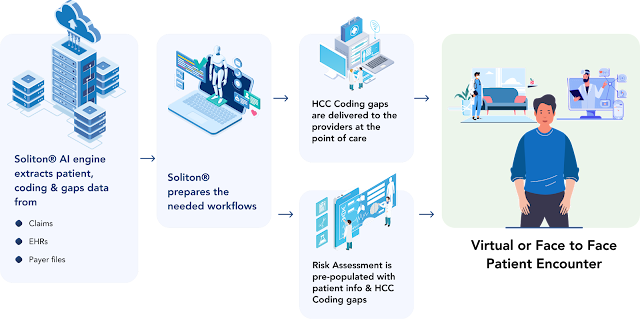
To ease the strain on healthcare providers and coders, healthcare organizations have started to use CMS Risk Adjustment Solution to identify and record particular conditions of every patient in their specified group. The HCC Coding assists CMS in properly and effectively aligning insurance payments to the resource needs of a Medicare Advantage (MA) group.


Tuesday, October 12, 2021

Advanced Analytics For Improved Population Health Management

 The healthcare industry uses the PopulationHealth Management Platform for ensuring positive outcomes for patients while lowering the care cost. To successfully implement the Population Health Management (PHM) model for value-based care, the payers, including health insurance companies and the government, need large sets of data and the ability to evaluate it.


Healthcare analytics provide macro and micro insights that aid decision-making at the patient and corporate levels. For proactive care, healthcare informatics and analytics must work together to find the latest healthcare trends, draw conclusions based on research findings and determine the areas for improvement.

The advanced analysis of healthcare data assists in evaluating existing procedures by using sophisticated data analysis tools, such as predictive analytics and machine-learning algorithms. The advanced analysis also plays a pivotal role in the identification of policy, procedure improvements, and the establishment of outcome variables based on verified correlations.

Population Health Management Solutions

To discover insights, generate recommendations and predictions, the Population Health Management Solutions combine healthcare data with modern data analytics to offer payers and providers an accurate assessment of the healthcare trends. The data gathering and visual analytics deliver statistical inferences for high-quality care.

Advanced Analytics

The process of analyzing quantitative data to report qualitative insights, answer questions, and detect trends is known as data analytics. Several tools and systems are utilized to extract, store, exchange, and analyze healthcare data including:


  • Electronic Health Records (EHRs)
  • Personal Health Records (PHRs)
  • Electronic Prescription Services (E-prescribing)
  • Patient Portals
  • Master Patient Indexes (MPI)
  • Health-Related Smart Phone Apps

Due to their complexity conventional data processing technologies, data transfer, and storage solutions are ineffective for these data sets. The centralized advanced analytic tools such as deep learning, data mining, big data, pattern matching, forecasting, visualization, multivariate statistics, neural networks, and cluster analysis profoundly affect the research and application of Population Health Management.

Secured cloud computing is critical for sensitive patient data. It's highly cost-effective and helps in bringing down the rising cost of care.

Types of Healthcare Data Analytics

The healthcare data is also helpful in predictive modeling to assist everyday operations for better care. The datasets track trends, create forecasts and help take preventive steps and monitor outcomes.

The four major types of healthcare data and, analytics are as follows:


  1. Descriptive Analytics

Descriptive analytics evaluates and discovers trends using statistical data by addressing inquiries and gaining insights concerning the past.


  1. Diagnostic Analytics

The diagnostic analytics explore the data and make correlations by understanding the cause and the patient’s symptoms.


  1. Predictive Analytics

The predictive analysis examines historical data, previous trends and makes appropriate predictions for the future.


  1. Prescriptive Analytics

Prescriptive analytics evaluate a patient's pre-existing diseases, predict the risk of future problems, and develop preventative clinical guidelines.

Conclusion

The advanced analytics of a Population Health Management Platform boosts efficiency across the board. Healthcare organizations and caregivers get precise models for decreasing costs and patient risk by using advanced analytics.


Thursday, October 7, 2021

The Context Of Care Coordination & Population Health Management Model

Population Health Management (PHM) aims to improve the healthcare quality of a group of individuals by monitoring and identifying specific patients within that group. The Population Health Management Platform provides real-time insights and coordinated interventions to care providers by identifying and addressing care gaps in the patient population.

The well-designed Population Health Management Solutions improves healthcare outcomes and cost reductions by providing solutions to identify and manage the quality of care. The PHM Solutions facilitate care coordination by supporting interoperability across care services to connect chronically ill patients and their families with preventive care, effective services, and resources.

Care Coordination Process

Care Coordination is a core component of the PHM platform that helps in the management of chronic conditions. It enables organizations to manage Pop Health effectively by developing connections between laboratory data, electronic health records, patient registries, and prescription data.

Care Coordination is an information-rich process that optimizes patient-centered sustainable care through big data, decision-making, assessment, planning, interventions, and evaluation. These procedures are carried out at the population and individual levels.

Big Data & Decision-Making

The data analysis determines the population’s specific requirements and problems particularly those at risk of fatality and complications. The data analysis also identifies the variables involved in problem-solving and decision-making for quality care.

Assessment

Assessment is an essential feature of Care Coordination as it ensures that crucial information is available for the planning and intervention stages. A thorough assessment identifies the high-risk individuals’ specific problems and needs that must be addressed and prioritized.

Planning

After gathering information about identified problems and needs of the target group, the planning phase helps address the issues. The first phase is to develop a plan to improve the health of the target group. There is a possibility that the target group may require more than one plan, depending on the intricacy of the problem or need.

 Interventions

The interventions should address the target group's needs adequately. The interventions fall into three distinct and interconnected categories:

   Preventive Measures:

The preventive measures focus on preventative care, early detection of disease, and injury prevention.

  Care Transitions:

Care Coordination during care transitions can identify the underlying factors of problems such as communication gaps related to sharing of clinical records and timely follow-ups with the caregiver.

  Care for Chronic Diseases

Clinical decision support systems are a critical element for providers who care for chronically sick patients.

Evaluation

The final stage of care coordination is an evaluation to improve care outcomes. Re-evaluate the care plan regularly and identify the new needs. Keep the healthcare report up-to-date by re-evaluating the data and insights from different sources.

Care Coordination for Payers

Healthcare Payers have an influence on care coordination; hence it is critical to have a system that allows easy transactions, data audits, reimbursements, approvals, and referrals connected to the healthcare system.


Monday, October 4, 2021

Population Health Management (PHM) is a method of providing Primary Health Care (PHC) that incorporates proactive outreach and community participation in the healthcare system. This methodology transforms PHC service delivery from reactive to proactive supervision of a population group at the lowest possible cost.


The Population Health Management Platform is becoming increasingly important due to the radical transformation in the healthcare system’s service provision and reimbursement techniques. It is compatible with value-based healthcare; a reimbursement structure that public and private payers widely adopt, Accountable Care Organizations (ACOs), and healthcare providers. Both the value-based healthcare paradigm and the PHM prioritize providing quality intervention while reducing the financial load on the healthcare system.

The funds are gradually being focused on outpatient care to reduce rehospitalizations. The payments have become more performance-based, boosting improvements in PHM. The preventive care strategy decreases the probability of patients developing critical (and costly) diseases in the future.

Population Health Management Strategies

Population Health Management strategies not only deliver sustained and customized value-based healthcare to a diversified patient population, but it also decreases the cost of healthcare plans, thus easing providers and payers’ financial load by encouraging proactive care and declining complication rates.

Care facilities, Pop Health outcomes, and health industry features are some of the aspects that affect an organization's PHM strategy. To meet new challenges, the organizations can employ the following PHM strategies to achieve sustained healthcare for the population:

  • Population Data Transformation
  • Analytic Transformation
  • Payment Transformation
  • Care Transformation

Population Data Transformation

Integrating a plethora of internal and external data such as clinical data, claims data, cost data, participation data, and socio-economic determinants of health, provides crucial guidance to organizations in regulating their resources, risks prospects, and plans to enhance healthcare effectively.

Analytic Transformation

Organizations need an analytical framework to identify and evaluate the population data to formulate the right PHM strategy for improved activities. Analytical transformation assists in synthesizing and prioritizing possibilities for the target population with the appropriate intervention. It also helps understand the healthcare cost and create plans for evaluation to ensure initiatives impact the right areas.

Payment Transformation

Organizations will be unable to enhance Pop Health if they adopt a value-based care model without the tech-based payment mechanism. Population Health Management for Payers must comprehend the overall healthcare cost by analyzing risk contracts to ensure that they are adequately paid for the services they provide.

Care Transformation

Organizations improve care management processes and outcomes to assist individuals across the healthcare system. Care transformation can be achieved by improving primary healthcare infrastructure, ensuring effective care is delivered at the right time, and increasing patient and provider involvement.

Conclusion

Effective PHM strategies encourage change at all levels of health service provision, including preventive and care management. Data-driven care management helps in lowering healthcare costs and improving patient outcomes.


Featured post

What Does The CMS TEAM Model Signal About The Future of CMS Payment Models?

The CMS TEAM Model (Transforming Episode Accountability Model) starts in 2026 and runs through 2030. CMS mandates participation for selecte...